(no subject)
May. 27th, 2004 11:12 am![[personal profile]](https://www.dreamwidth.org/img/silk/identity/user.png) winterbadger
winterbadger![[livejournal.com profile]](https://www.dreamwidth.org/img/external/lj-userinfo.gif) robbysmom and I were having an email conversation about this statement from a recent speech by Al Gore
robbysmom and I were having an email conversation about this statement from a recent speech by Al GoreZinni's book will join a growing library of volumes by former advisors to Bush -- including his principal advisor on terrorism, Richard Clarke; his principal economic policy advisor, former Treasury Secretary Paul O'Neill, former Ambassador Joe Wilson, who was honored by Bush's father for his service in Iraq, and his former Domestic Adviser on faith-based organizations, John Dilulio, who said, "There is no precedent in any modern White House for what is going on in this one: a complete lack of a policy apparatus. What you've got is everything, and I mean everything, run by the political arm. It's the reign of the Mayberry Machiavellis."
My first reaction to the observation that everything was being "run by the political arm" was
I wonder about this. One of the things that I realized after several years of delighting in every minute of Aaron Sorkin's American President and it's TV successor, The West Wing, was that it depicted a president surrounded at almost all times by his chief of staff (who had been his campaign manager), his deputy COS (who was the campaign's chief political advisor and whose White House role was almost entirely political liaison with Congress), his press secretary, and his chief and deputy communication directors (who had been his campaign speechwriters). During his reelection campaign they were supplemented by an additional political consultant and his staff, and a polling consultant.
Meanwhile, the national security advisor and the director of central intelligence rarely appeared outside the Situation Room, the defense secretary didn't even always show up there--and bitterly hated and was hated by the president--and I don't think they had an actor to portray the secretary of state until the third or fourth season. Other cabinet officials? I'm not sure if there was a treasury secretary. The agriculture secrtary was introduced only because he had to stay in the Oval Office during a state of the union address. Of all the senior officers of foreign policy, only the chair of the Joint Chiefs was a regular visitor in the Oval Office, partly because the story arc required us to see the president slowly becoming more trusting of the military and vice versa.
In other words, the most critical people in the White House, the people who the president sees most often and are around him all the time are not the actual officers of government, but political advisors whose primary credentials *and* responsibilities are getting the president elected and reelected. In other words, in the ideal liberal's White House, everything is being run by the political arm, as Gore charges the Bush administration.
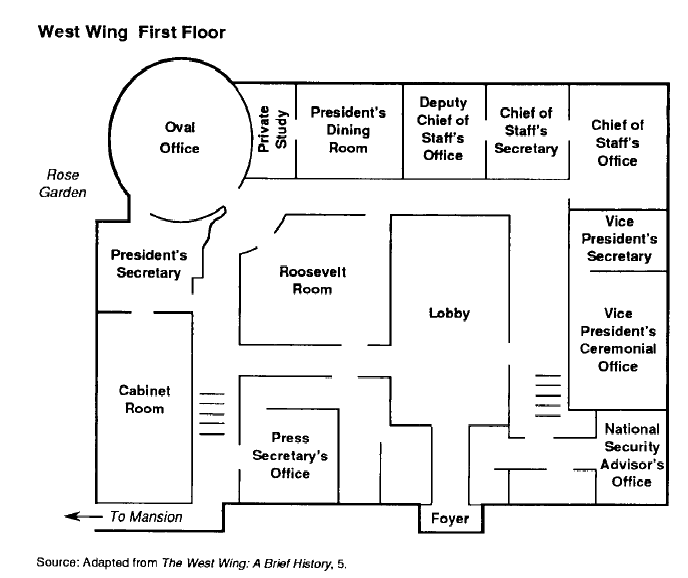
So what? It's just a TV show, right? Well, I looked at a plan of the current West Wing offices. I notice that the president's office and study are surrounded by meeting rooms and assistants for policy and operations (presumably political appointees/advisors). I suppose one can onbserve that the senior advisors are going to see the president only when there are meetings,a nd that the president is closer to the meeting rooms than anyone else.
But I also notice that the chief of staff and the national security advisor are about as far away from the president's offices as it is possible to be on the ground floor of the West Wing. Admittedly, they are corner offices, which the article notes are highly desirable. But they are also in very close proximity to the vice president's office... Alas, this is apparently fairly traditional: see a floorplan circa 1990.
then I thought some more and
Well, and in the defense of presidents past and future, in one sense it's not surprising that their closest advisors for national policy are their closest advisors from the campaign. These are the people they trust the most, and the people who have helped to shape their policy positions when they were candidates, positions that to a large extent helped them get elected. It's only a problem when policy decisions in office are taken for reasons that relate, not to what the best choice for the country is, but for what the best choice for that politician's career is.
And even then... all the US political science theory I learned suggested that our system is not designed based on the premise that we can tell who the most moral, most altruistic men and women are, the ones who are rare geniuses who will see the right course for the country and pursue that whatever the political cost to themselves. It's based, in a very Adam Smithian assumption that if voters in each district elect candidates who will represent their views, that somehow out of the interaction and conflict of all of those representatives will come policy that steers teh country in the best direction. We don't elect people because we think they're necessarily smart or more capable than we; we elect them because all 293 million of us can't sit down together every time a national decision needs to be made and discuss it.
Now, hopefully when we elect someone to represent us, "represent" is used in its largest sense: not just someone who shares our views on policy but also someone who can act as we would if we were there, with our values and our beliefs and our code of personal and civic conduct. Inevitably, there is a restricted field of people willing or able to run for office, and we're left with what people often refer to as the choice of "the better of two [or more] evils"; I understand the sentiment that motivates this commonplace, but we're getting what our system is designed to provide, and what many people around the world don't get: an opportunity to choose which of several candidates is best suited to carry out our government for us.
Yes, politicians often make policy choices based on consideration of what is most likely to please their constituents and get them reelected. But that, after all, is the behavior that representative democracy is designed to induce; would we be happier if politicians *didn't* want to get reelected and therefore did whatever they felt like, instead of what they thought we wanted them to do?


Re: Polls, Marketing, Representation
Date: 2004-05-27 11:09 pm (UTC)Someday, someday, in my dream world, the Supreme Court is going to reverse itself on Buckley v. Valeo. That is the root of the worst problems of money = votes in America, and it is manifestly and wholly antidemocratic.
the toothpaste I use (Tom's propylis, fwiw)
Me too! :-)
I just also expect my representative, if he or she feels that a conflict between the views of a majority of constituents and what's right, to say so-- to me and in his or her votiong record.
I'm torn between agreeing and thinking, "Yeah, but what if 'what's right' from the politician's POV is the No Gay Marriage amendment or a ban on abortions?" I sure as heck don't want my rep "voting his/her conscience" then!!